

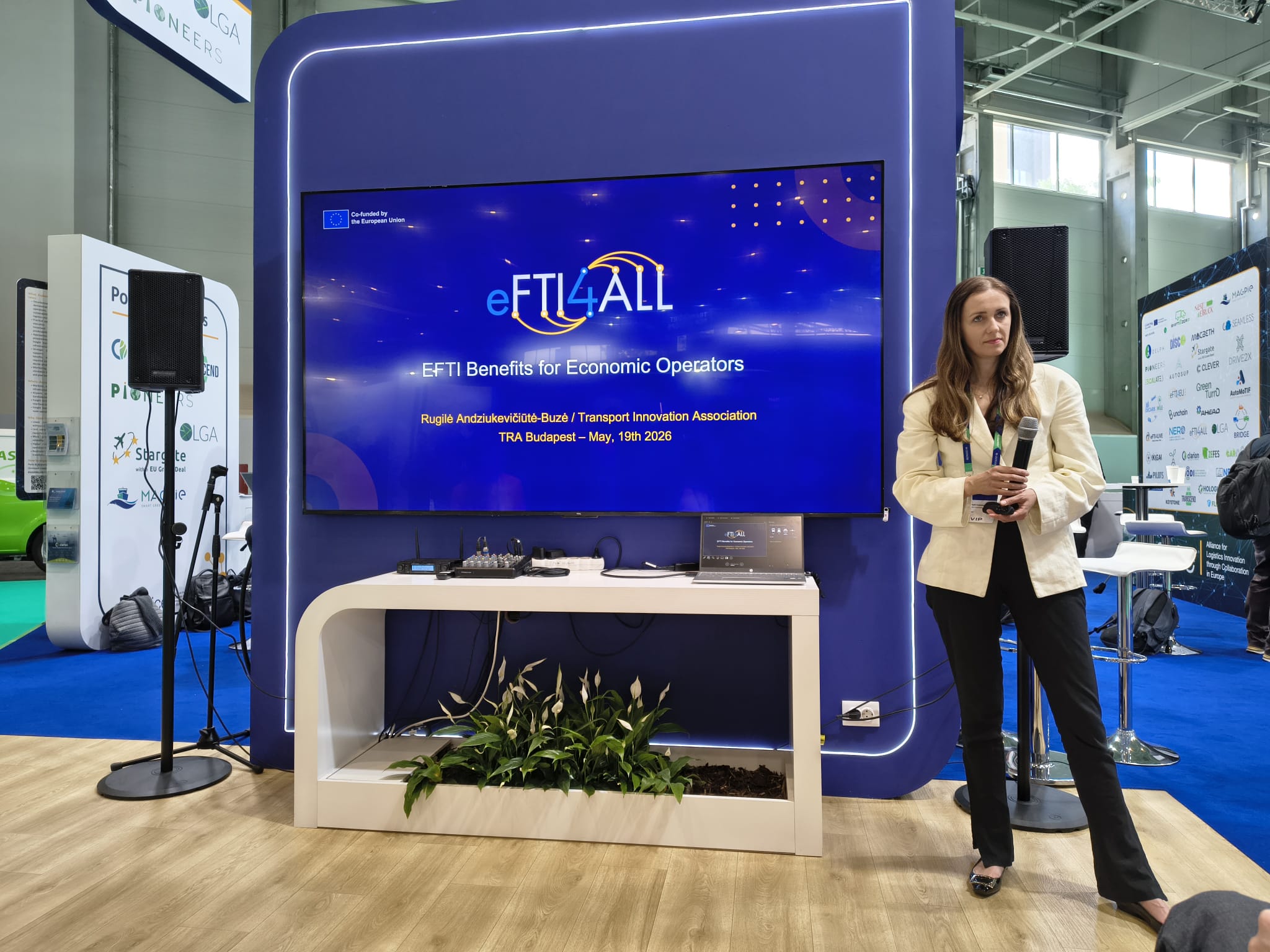

The Transport Research Arena (TRA) 2026 in Budapest provided an excellent opportunity for the eFTI community to come together and discuss the future of freight transport digitalisation in Europe.
Together with our sister projects eFTI4EU and eFTI4LIVE, the eFTI4ALL project participated in the event through a shared presence at the ALICE pavilion, engaging with stakeholders from across the transport, logistics, technology, and public sectors. Throughout the event, project representatives presented different perspectives on the implementation of the eFTI Regulation, highlighting both practical use cases and business opportunities.
The event also provided valuable opportunities for direct exchanges with visitors, allowing the project team to discuss the challenges and opportunities linked to freight transport digitalisation and the upcoming implementation of eFTI. Many attendees stopped by the stand to learn more about the initiative, while others took part in an interactive quiz designed to test their knowledge of eFTI and its role in the future of European logistics.
During the four-days event, two presentations delivered under the eFTI4ALL umbrella attracted particular interest from participants.
Dangerous Goods transport: a strong use case for eFTI
During his presentation, André Perpey (NeoGLS) explored how eFTI can support the digitalisation of dangerous goods transport, a sector where both operational efficiency and safety are critical.
Transporting dangerous goods requires strict compliance with regulatory requirements, accurate documentation, and highly reliable operational processes. According to André Perpey, these characteristics also make the sector particularly well positioned for eFTI adoption. Operators involved in dangerous goods transport are already familiar with certification procedures, regulatory compliance, and standardised information exchange processes.
One of the key benefits of eFTI is its ability to provide a common European framework capable of supporting different regulatory environments, including ADR for road transport, RID for rail transport, and ADN for inland waterways.
Within this context, eFTI platforms play a central role. They act as trusted intermediaries connecting economic operators, existing information systems, and competent authorities, enabling more structured, secure, and reliable information exchange across the transport chain.
As digitalisation progresses, dangerous goods transport represents a compelling example of how eFTI can simplify compliance while maintaining the high levels of safety and traceability required by the sector.

Why eFTI Is a Natural Next Step for Businesses
A second presentation, delivered by Rugilė Andziukevičiūtė-Buzė (Transport Innovation Association), focused on the business perspective and the practical value that eFTI can create for economic operators.
A key message of the presentation was that transport digitalisation is already happening, regardless of eFTI. Across Europe, transport and logistics companies are increasingly adopting telematics systems, transport management systems, ERP integrations, APIs, eCMR solutions, real-time data exchange tools, customs digitalisation services, and AI-powered planning platforms.
In this evolving environment, eFTI should not be seen merely as a regulatory requirement. Instead, it represents a natural next step in the broader digital transformation journey already underway within the sector.

For businesses, the benefits go beyond compliance. eFTI can contribute to reducing administrative burdens, improving data quality, increasing traceability, and lowering the risk of errors and penalties. It can also facilitate smoother integration with customers, partners, and public authorities, helping create more efficient and connected logistics processes.
Ultimately, eFTI supports a broader vision of freight transport where information flows seamlessly between stakeholders, enabling companies to become more competitive, agile, and prepared for future digital services.
From Regulation to Real Business Benefits
The discussions held during TRA 2026 once again demonstrated that eFTI is not only a regulatory initiative but also a catalyst for innovation and operational improvement across the logistics sector.
Whether supporting highly regulated activities such as dangerous goods transport or helping companies unlock new efficiencies through digitalisation, eFTI continues to show its potential to deliver tangible value to both public and private stakeholders.
As implementation activities progress across Europe, eFTI4ALL will continue working with industry, authorities, and technology providers to help turn this potential into reality.